
Empowering European Manufacturing SMEs through Collaboration and Innovation

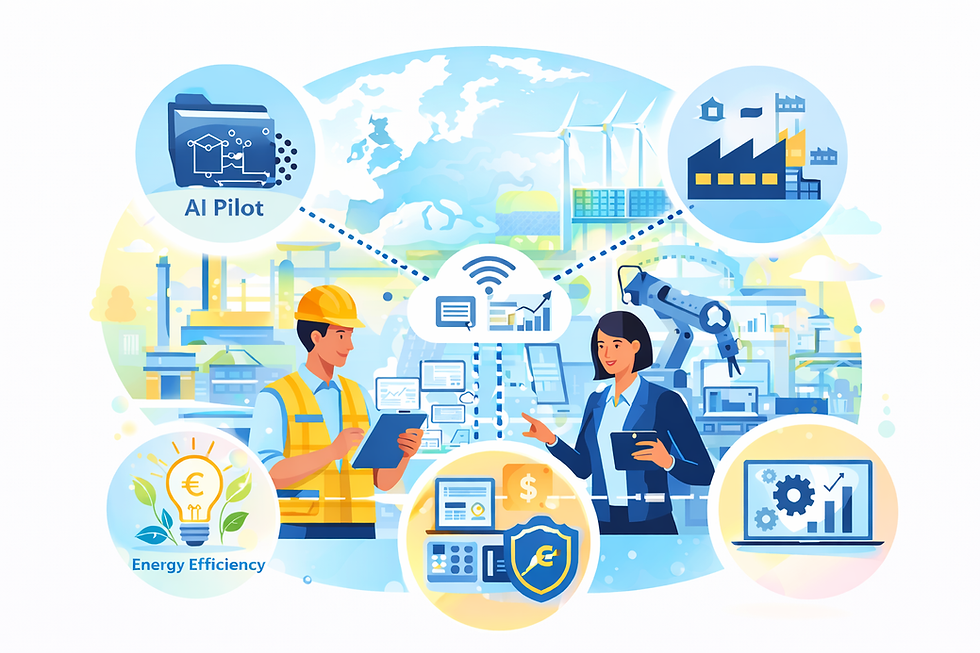
European manufacturers — from family-owned workshops to agile small factories — are entering a period of rapid change. Advances in digital technology (Industry 4.0, AI) and the green energy transition are reshaping how products are made, delivered, and sold. These trends bring real challenges — like finding skilled workers and managing rising energy costs — but they also open up new opportunities.
One helpful way to look at it is this: SMEs don’t have to solve everything alone. By sharing knowledge, pooling resources, and tapping EU support, small and mid-sized manufacturers can turn pressure into progress.
Across Europe, many SMEs face the same hurdles — skills shortages, energy volatility, and fast-moving regulations — so collaboration simply makes sense. For example, OECD work highlights that a large share of SMEs use digitally gathered data to support decisions and report benefits such as increased sales, broader reach, and productivity improvements. [1] And many SMEs are already experimenting with AI in practical ways, often starting with low-risk pilots. [1]
What’s needed now is a supportive environment of shared solutions, training, and funding — so that every factory, whether in Berlin, Milan, Porto, or beyond, can keep up and thrive.
What SMEs are already doing (and why it’s working)
Data & AI adoption: With simple digital tools (online sales platforms, basic sensors, ERP or cloud apps), even a 50-person manufacturer can improve planning, reduce waste, and respond faster to customers. OECD findings connect digital adoption with benefits like higher domestic sales, wider customer reach, and productivity gains through automation. [1]
Energy & sustainability: Surging energy and material prices make efficiency a priority. Digital tools like smart meters and process controls can help reduce energy use — depending on the baseline and process. The EU and the European Investment Bank are also backing SMEs with major financing to support energy efficiency and decarbonisation measures (2025–2027). [2]
Skills & training: Finding qualified workers remains a top concern. EU programmes support vocational training and cross-border placements, including practical apprenticeships and work-based learning. [6] Talent and mobility pathways also exist to help companies access skills where they’re needed.
Working Together with EU and Industry Networks
Europe offers a rich ecosystem of collaboration platforms. For SMEs, these networks can reduce risk, lower cost, and shorten the learning curve.
EU Funding & Innovation Programmes
The EU’s Horizon Europe programme (2021–2027) supports research and innovation across areas including industrial digitalisation and decarbonisation. [3] Other funding pathways (including InvestEU) also support sustainable investment, innovation, and SME growth. [7]
Digital Innovation Hubs & Competence Centres
Across Europe, European Digital Innovation Hubs (EDIHs) act as “one-stop shops” to help companies become more competitive through digital technologies. [4]In Germany, the Mittelstand-Digital / Mittelstand 4.0 Competence Centres provide practical, provider-neutral support, training, and demonstrations for SMEs. [5]
These hubs often help SMEs:
test technologies before investing,
access expertise and training,
find funding guidance,
connect with partners and peers.
Industry Alliances & Knowledge-Sharing
Industrial alliances and trade networks help SMEs participate in larger value chains and learn from what’s already working. The EU AI Act also includes measures intended to support SMEs and startups — including priority access to AI regulatory sandboxes and reduced fees for conformity assessments. [8]
Skills Partnerships
Alongside technology, people remain the heart of manufacturing. SMEs can benefit from skills partnerships with vocational providers and EU mobility programmes, including support for work placements abroad for VET learners and recent graduates. [6] Even small initiatives like an “innovation day” or internal mentoring system can make digital adoption much smoother.
Taking Action: SME Next Steps
If you want practical progress without disruption, small steps are often the most effective.
Engage your peers. Join industry forums, local manufacturing clusters, or digital hubs. Attend workshops to see what’s working elsewhere — and share what you learn.
Explore funding & support. Check EU and national calls. Whether it’s Horizon Europe opportunities, InvestEU pathways, or hub-supported vouchers, there are options designed to reduce SME investment risk. [3] [7]
Focus on quick wins. Even a 5% improvement adds up. Start with an ERP module, basic IoT sensors, or structured data capture for downtime and quality issues — then scale what works.
Above all, keep a long-term mindset. Innovation is ongoing: additive manufacturing, traceability solutions, advanced sensors, and AI-supported maintenance are evolving quickly. By staying connected and learning from peers, SMEs can stay ahead without chasing hype.
A Positive Outlook
European SMEs have strong allies. The combined efforts of national programmes, EU initiatives, and industry networks mean more support than ever — especially in the areas of digitalisation and sustainability.
The big takeaway is simple: collaboration over isolation. When SMEs share best practices, use trusted networks, and leverage available support, they can reach efficiencies and innovations that once felt out of reach.
Every manufacturer in Europe — big or small — has a role to play and resources to gain. Now is a great time to connect, learn, and act: explore available grants, join a digital hub, train your team on new tools — and encourage your peers to do the same.
Together, European SMEs won’t just manage the digital and green transitions. They can genuinely thrive in them.
Quick Question
Where should you start with digitalisation, energy efficiency, or a small AI pilot? And how can you implement it without disrupting production? If you’d like a practical second opinion, feel free to reach out.
Resources & Reference Links
Disclaimer: This article is provided for general informational purposes only and reflects publicly available discussions and policy materials as of 2024–2025. It does not constitute legal, financial, or professional advice. Readers should consult qualified professionals before making business decisions. References to EU institutions and programmes are for information only and do not imply endorsement or affiliation.
Written by Poonam Khatti
Founder of Creacadlnn, an engineering consultancy providing services in product design, mechanical engineering, and visual communication. I write about manufacturing SMEs, digital transformation, outsourcing, and sustainable product development for European and global markets.


Comments